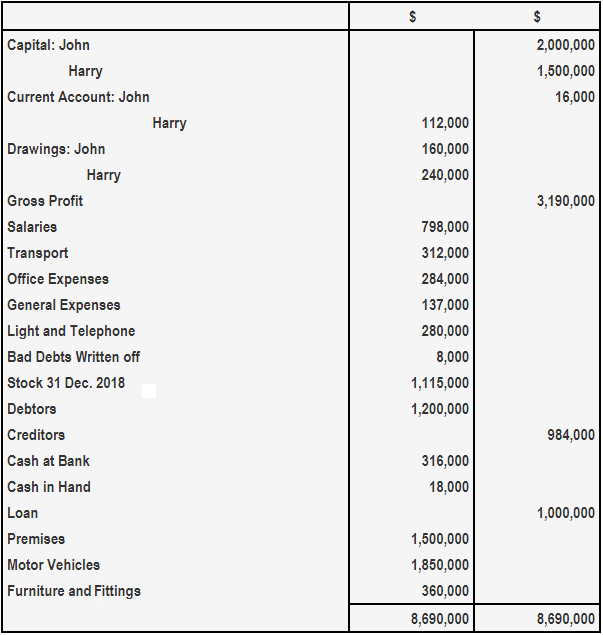
The single-step P&L Statement operates on this principle, collating all revenues and subtracting all expenses in one clean sweep. It’s the bottom line, the figure most stakeholders dart their eyes towards. It’s the culmination of all business activities and decisions reflected in one number.
Are All Companies Required to Prepare P&L Statements?
In economics, when an agent is risk neutral, the objective function is simply expressed as the expected value of a monetary quantity, such as profit, income, or end-of-period wealth. For risk-averse or risk-loving agents, loss is measured as the negative of a utility function, and the objective function to be optimized is the expected value of utility. “Loss”, sometimes referred to as “Loss.jpg”,[1] is a strip published on June 2, 2008, by Tim Buckley for his gaming-related webcomic Ctrl+Alt+Del. At the end of the day, shareholders bear the ultimate risk for a company’s financial losses.
- Companies that invest wisely in compliance may actually decrease their overall financial risk.
- Most companies buy raw materials in bulk from manufacturers and wholesalers on credit, with an agreement to pay at a later date.
- Below is a break down of subject weightings in the FMVA® financial analyst program.
Interpretation of Profit and Loss Statement
Clubbing them with regular income or expenses can paint a distorted image of business health. Revenue losses are losses incurred in trading operations, such as losses on the sale of merchandise. P&L management refers to how a company handles its P&L statement through revenue and cost management.
Our Services
Our writing and editorial staff are a team of experts holding advanced financial designations and have written for most major financial media publications. Our work has been directly cited by organizations including Entrepreneur, Business Insider, Investopedia, Forbes, CNBC, and many others. Our team of reviewers are established professionals with decades of experience in areas of personal finance and hold many advanced degrees and certifications. 11 Financial is a registered investment adviser located in Lufkin, Texas. 11 Financial may only transact business in those states in which it is registered, or qualifies for an exemption or exclusion from registration requirements. 11 Financial’s website is limited to the dissemination of general information pertaining to its advisory services, together with access to additional investment-related information, publications, and links.

How to Claim Losses From a Small Business on Taxes
It guarantees that growth in revenue translates to increased profitability, rather than being eaten up by escalating costs. While revenue signals potential profitability, COGS is the pinch that reminds businesses of the cost of doing business. For information pertaining to the registration status of 11 Financial, please contact the state securities regulators for those states in which 11 Financial maintains a registration filing. Also, a discount on the issuance of shares or debentures is a capital loss.
Maintaining a balance sheet that shows profitability is key to retaining investor confidence and thus protecting shareholder value. The loss carryforward and carryback strategies offer businesses the opportunity to stabilize their effective tax rates, providing a cushion during lean business periods by transferring losses into profitable years. This financial flexibility makes them integral tools in corporate tax planning. Loss carryforwards and carrybacks are essential tools available to corporations, which allow them to strategically manage their tax liabilities.
A policyholder makes a claim for compensation when he/she suffers a loss on the insured loss or event. For example, if the policyholder purchased flood insurance coverage for his business and floods cause damage to the business, the insurance company will be required to compensate the policyholder. Examining year-on-year sales growth and seasonal patterns can reveal market shifts, competition moves, or internal challenges when revenue experiences dips. The P&L statement, in its detailed glory, offers this transparency to investors and stakeholders.
Investors and analysts will typically give far more weight to these metrics than losses or gains. A profit and loss (P&L) statement is one of the three types of financial statements prepared by companies. The purpose of the P&L statement is to show a company’s revenues and expenditures over a specified period of time, usually over one fiscal year. The P&L or income statement, like the cash flow statement, shows changes in accounts over a set period of time. The balance sheet, on the other hand, is a snapshot, showing what the company owns and owes at a single moment. It is important to compare the income statement with the cash flow statement since, under the accrual method of accounting, a company can log revenues and expenses before cash changes hands.
If the tech sector experiences a downturn due to new legislation or market saturation, the value of those shares could decrease, resulting in a financial loss for the investor. Similarly, a sudden increase in the interest rates set by the central bank can lead to lower spending in the economy, which can negatively affect a business’s bottom line. Sustainable growth targets also consider a firm’s commitment towards Corporate Social Responsibility (CSR). However, continuous losses can deter a company’s commitment to its CSR objectives as resources are redirected towards safeguarding the survival of the firm.
A loss is an excess of expenses over revenues, either for a single business transaction or in reference to the sum of all transactions for an accounting period. The presence of a loss for an accounting period is closely watched by investors and creditors, since it can signal a decline in the creditworthiness of a business. A loss in finance refers to the negative difference between total costs california earned income tax credit and young child tax credit and total revenues, where costs exceed revenues, resulting in a decrease in net income or net worth. It indicates that the expenses of operating a business or an investment outweigh the profits earned. When evaluating a profit and loss statement, it is important to consider statements from previous periods to get a more accurate sense of the rate of change in a company’s revenues and expenses.